
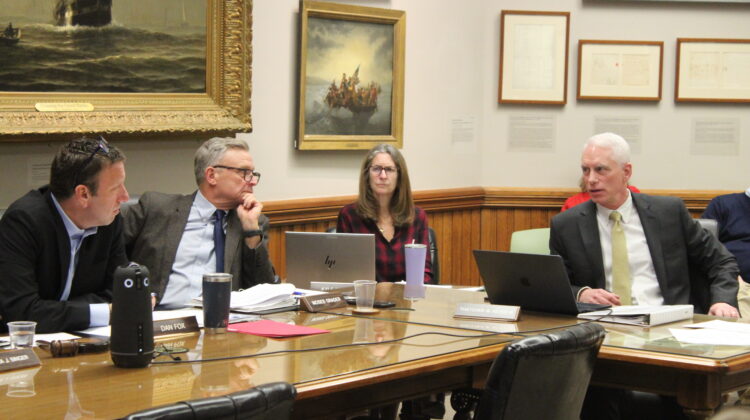
Marblehead officials are entering the FY2027 budget season facing what multiple town leaders describe as a structural financial crisis — one marked by rising fixed costs, constrained revenues, and increasingly stark choices about staffing and services.
Over the past six weeks, budget forecasts, public presentations, and committee meetings have revealed a widening gap between what the town can afford to pay for, what the current level of services costs, and what it currently spends.
Depending on the assumptions used, that gap ranges from roughly $7 million to more than $8.5 million for FY27. This divergence has itself become a source of concern as officials work toward the May Town Meeting.
In December, Finance Committee Chair Alec Goolsby, Finance Director Aleesha Benjamin, and Finance Committee Vice Chair Molly Teets walked the Select Board through a preliminary, multi-year budget forecast built as a baseline exercise.
That analysis assumed current staffing and service levels would remain unchanged and was intended to show what the town’s finances would look like in the absence of any intervention.
Under that scenario, revenues were shown to be tightly constrained by Proposition 2½, with the property tax levy projected to grow by about $2.2 million in FY27 annually. At the same time, other revenue sources were weakening: free cash was projected to decline by approximately $2 million, while local receipts were expected to fall by about $1 million, largely due to lower investment earnings.
Expenses, however, continued to rise. Total municipal spending was projected to exceed $100 million, driven overwhelmingly by salaries, benefits, pensions, and health insurance. Based on those assumptions, officials estimated a gap of roughly $7 million in FY27, growing to as much as $15 million by FY29 if no corrective action were taken.
Goolsby emphasized at the time that the December forecast was not a spending plan, but a starting point.
“This is what it looks like if we just keep operating exactly how we are,” he said, stressing the importance of understanding existing costs before debating cuts or new revenue.
That context became critical weeks later, when Town Administrator Thatcher Kezer presented a more immediate and significantly larger figure at the State of the Town address: an $8.4 million projected shortfall for FY27.
Kezer attributed the gap to both declining revenues and rising fixed costs, citing more than $2.2 million less in revenue available for appropriation and more than $6.1 million in additional expenses. He warned that balancing the budget using existing revenues alone would require eliminating more than 50 municipal positions — roughly 15% of the workforce — and funding only the most essential services, such as public safety.
The contrast between the December forecast and the State of the Town presentation has since drawn scrutiny from the Finance Committee, particularly because the earlier projection assumed higher school spending growth than what was later presented publicly. At the State of the Town Meeting in January, it was projected that the schools would request $870,000 and the town, $5,952,608.
Finance Committee members have questioned why the overall gap appeared to widen rather than narrow as school budget assumptions decreased, pressing for clearer, department-by-department explanations of how the numbers changed.
Despite differing topline figures, officials across meetings have consistently pointed to the same underlying constraint: roughly 80% of the town’s budget is tied to personnel and related obligations, leaving little flexibility when revenues fall short.
Health insurance remains one of the most unpredictable cost drivers. Benjamin has warned that early guidance from the state’s Group Insurance Commission suggests potential premium increases of 15% to 18% for FY27. Even at the low end, that increase would absorb nearly all of the town’s annual growth in property tax revenue. These projected increases, as presented by Benjamin, are a significant contrast from what the Commonwealth of Massachusetts Group Insurance Commission noted in their January 2026 documents, they released which state GIC costs are estimated to rise 8.9% – 12.9%. Historically, the insurance budget has been the major source of end-of-year budget surpluses due to over-budgeting, which results in free cash each year.
Pension costs are also rising on a fixed actuarial schedule, increasing by more than $460,000 in FY27, while a new trash collection contract is expected to add roughly $800,000 annually.
“These are obligations,” Kezer said. “There’s no say in them.”
While town-side budgets remain unsettled, Marblehead Public Schools have already begun making reductions for FY27.
At a Jan. 29 School Committee Budget Subcommittee meeting, administrators presented a proposed school budget that eliminates five teaching positions across the district, saving approximately $375,000. The cuts affect three positions at Marblehead High School, one at the Middle School, and one at the Veterans School. District leaders said they hope to achieve the reductions through attrition rather than layoffs.
A maintenance worker position funded at $71,000 in FY26 is also being eliminated. Assistant Superintendent of Finance and Operations Michael Pifferling acknowledged the impact of that cut, noting that recent improvements in building maintenance could be affected.
The district also proposed a temporary $200,000 reduction in special education tuition pre-payments for FY28. This would still leave $800,000 in the FY27 budget that is being earmarked to pre-pay tuitions for the 2027-2028 school year. Administrators described the move as a short-term adjustment rather than a structural fix, emphasizing that it relies on reserves and timing shifts rather than permanent savings.
School officials have also been clear that the steps taken for FY27 create additional pressure in FY28. The reduced pre-payments, reliance on reserves and contractual increases, and use of one-time adjustments mean that these deductions would need to be restored or added in FY28 to avoid deeper programmatic cuts, particularly if special education costs rise or students placed out of district are not brought back in-house as planned.
Administrators described the approach as buying time — using reserves and temporary reductions now while working to stabilize special education programming and staffing — rather than resolving the underlying cost growth.
As the figures have grown more concrete, the Finance Committee has pushed for greater transparency from the town before accepting the higher gap estimates as settled. At its first meeting following the State of the Town address, members questioned how assumptions had shifted since December and requested detailed breakdowns of town-side spending.
Benjamin told the committee she has instructed departments to submit level-funded budgets adjusted only for contractual obligations, not for the cuts required to achieve balance. She said she expects to present a balanced proposal to the Select Board in the coming weeks.
Committee members also raised concerns about timing, noting that significant analysis, public discussion, and difficult decisions still lie ahead before the warrant is finalized.
Despite mounting pressure, finance officials have cautioned against prematurely focusing on a Proposition 2½ override. Goolsby has emphasized that the town must first fully understand its cost structure and options before asking voters for additional revenue.
Others, including Kezer, have framed the decision more broadly.
“Ultimately, it’s a community conversation about values,” he said. “What does the Marblehead we want look like, and how are we going to support it?”
Officials stress that the numbers are still evolving. State aid figures, final health insurance rates, free cash certification, and negotiated contracts could all shift the outcome.
What is clear, however, is that Marblehead is approaching a defining budget cycle — one that will force residents and leaders alike to grapple not only with how large the gap is, but with why the numbers differ, what assumptions underpin them, and how much risk the town is willing to carry into future years.